


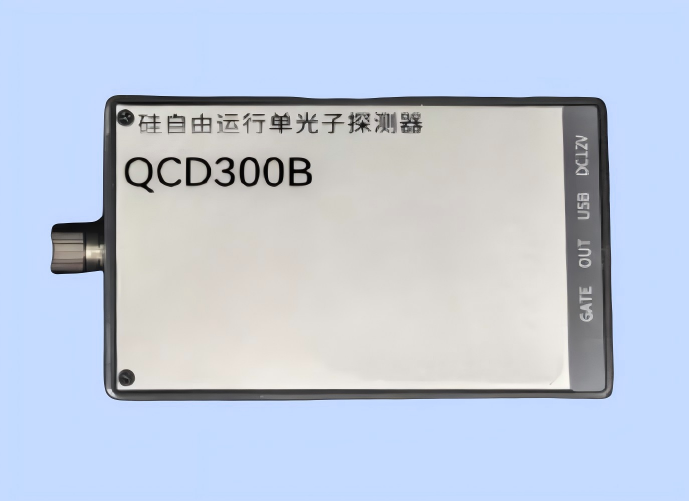
ROF Si photondetector avalanche photodiodes free running single photon detector

Feature
- Single photon detection: Capable of detecting single photon signals in the visible light band;
- USB communication: Supports communication with the host computer via the USB 2.0 protocol, enabling parameter configuration download, status reporting, data upload, and related debugging functions;
- High reliability: Maintains system performance stability in different working environment temperatures through active stabilization algorithms;
- Easy maintenance: Supports real-time monitoring and control of system status;
Application
The application fields of the R-QCD300 series of silicon free-running single-photon detectors include: single-photon lidar, fluorescence lifetime detection, single-photon imaging, quantum communication, quantum optics, optical time-domain reflection, etc. Typical applications are shown in the following figure.

Figure 1 Schematic diagram of typical application scenarios of the product
In applications such as single-photon lidar and single-photon imaging, a pulsed laser beam is emitted from the laser to the target. The signal photons scatter or reflect when encountering molecules in the air or hard targets. After being collected at the laser emission point, the scattered or diffuse reflected echo photon signals are collected. These signals are detected using single-photon detectors, and the detection signals are analyzed in conjunction with the laser emission signals using time digital converters to obtain the photon flight time. Finally, the distance of the target object is calculated using the speed of light. In atmospheric lidar applications, the backscattered laser from the atmosphere is detected to obtain physical information of the atmosphere. In three-dimensional imaging lidar applications, the distance information of each pixel is obtained through scanning, and then the three-dimensional image of the detected target is accurately reconstructed using imaging algorithms. Due to the inverse square relationship between the power of the echo signal received by the lidar and the detection distance, as the detection distance increases, the signal strength will sharply weaken. Moreover, because the laser is scattered and absorbed by the atmosphere during its round trip, the signal strength will further decrease. Compared to traditional photoelectric detectors, single-photon detectors have higher sensitivity and can respond to individual photon signals, enabling longer-distance detection and reducing the dependence on the laser emission power.
Parameters
|
Project |
R-QCD300B-S-3 |
|
|
parameter indicators |
response wavelength |
400 - 900nm |
|
number of channels |
single channel |
|
|
Coupling method |
62.5um/105um multimode fiber @ UPC interface |
|
|
Detection efficiency @ λ=850nm |
Maximum 65%, typical value 60% |
|
|
Dark count rate |
≤100cps |
|
|
Post pulse probability |
≤ 8% @ 100ns dead time |
|
|
Time jitter |
Minimum 350ps, typical value 500ps |
|
|
Dead time adjustment |
0ns-63ns |
|
|
Saturation count rate |
≥ 8Mcps@100ns Death time |
|
|
Specifications |
size |
Width 110mm, height 35mm, depth 72mm |
|
weight |
Net weight approximately 300g |
|
|
power supply |
DC 12V |
|
|
Maximum power consumption of the whole machine |
≤8W |
|
|
environmental adaptability |
Operating Temperature |
-10 ~ 55℃ |
|
Storage temperature |
-40 ~ 85℃ |
|
|
Operating Humidity |
10% ~ 90%RH |
|
|
storage humidity |
10% ~ 90%RH |
|
*please contact our seller if you have special requirements
About Us
Rofea Optoelectronics exhibits a wide range of electro-optic products including modulators, photodetectors, laser sources, dfb lasers, optical amplifiers, EDFAs, SLD lasers, QPSK modulation, pulsed lasers, photodetectors, balanced photodetectors, semiconductor lasers, laser Drivers, fiber couplers, pulsed lasers, fiber amplifiers, optical power meters, broadband lasers, tunable lasers, optical delays, electro-optic modulators, photodetectors, laser diode drivers, fiber amplifiers, erbium-doped fiber amplifiers, and source lasers.
We also provide custom modulators, including 1*4 array phase modulators, ultra-low Vpi and ultra-high extinction ratio modulators, which are specially designed for universities and research institutes.
These products feature electro-optic bandwidth up to 40 GHz, wavelength range from 780 nm to 2000 nm, low insertion loss, low Vp, and high PER, making them suitable for a variety of analog RF links and high-speed communication applications.
Rofea Optoelectronics offers a product line of commercial Electro-optic modulators, Phase modulators, Intensity modulator, Photodetectors, Laser light sources, DFB lasers,Optical amplifiers, EDFA, SLD laser, QPSK modulation, Pulse laser, Light detector, Balanced photodetector, Laser driver, Fiber optic amplifier, Optical power meter, Broadband laser, Tunable laser, Optical detector, Laser diode driver, Fiber amplifier. We also provide many particular modulators for customization, such as 1*4 array phase modulators, ultra-low Vpi, and ultra-high extinction ratio modulators, primarily used in universities and institutes.
Hope our products will be helpful to you and your research.


